Apadana
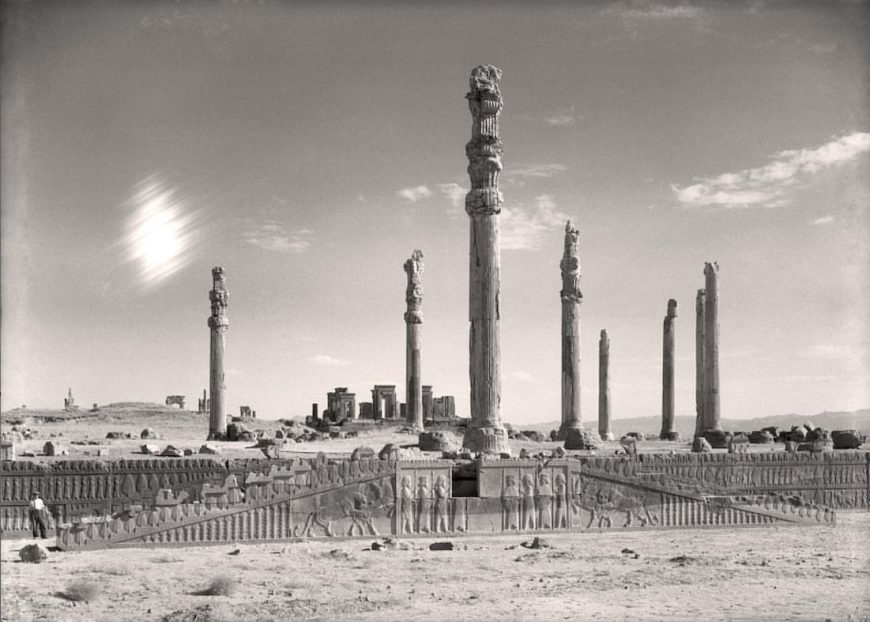 |
| View of the eastern stairway and columns of the Apadana (Audience Hall) at Persepolis, Iran, 5th century B.C.E. |
Persepolis, a Persian city founded by Darius the Great and completed by his son Xerxes, included a columned hall, called the Apadana. Out of the remaining 13, this hall once contained 72 columns and two stairways. The word "apadana" was originally used to indicate an audience hall, but this one was so elaborate and advanced that the word slowly shifted its meaning. So much so, that every other hall no longer deserved the same title.
The Apadana appeared to be functioning as a royal audience hall, where kings would receive royal delegations from all over the empire. This of course was more than an acceptable way to receive delegations due to the fact that it could house around 10,000 people at once. With the king's seat lifted at the far end, the hall also functioned as a way to make anyone there feel lower in status than the king. Another essential part of this design was the view. The group floor rose above the surrounding plain by 131 feet. This provided the king with the ability to watch over the city and its surroundings as well as troops of soldiers, regardless of whether they were in formation or parading.
The visual elements of this magnificent hall included winged bulls and lions, all of which were double headed, there were carvings of people with gifts and Darius the Great's soldiers. This all had a single purpose, to put fear into the mind and show the Persian power, strength, and wealth. Other elements included floral designs or intricate carvings, this tells us that the Persians had a passion for detail.
The style of the Apadana and city of Persepolis is believed to have influenced the minds of those who came after. Some of the Umayyad Caliphate's earliest mosques, like the great Mosque of Banu Umayya, had been influenced without a doubt by the designs of the Apadana. You can see this in the pillar designs. The Great Mosque of Banu also includes the Dome of Treasury, "Qubbat al-Khazna". This rests on columns that have clear similarities to the ancient Persian hall of Apadana.
 |
| Reconstruction of the Apadana's roof |
References
Vučković, A. (2020, May 19). Apadana – The Everlasting Hall of the Achaemenids. Retrieved September 03, 2020, from https://www.ancient-origins.net/ancient-places-asia/apadana-0012649
German, D. (n.d.). Ancient Persia, an introduction. Retrieved September 03, 2020, from https://smarthistory.org/persian-art-an-introduction/

Comments
Post a Comment