Great Mosque at Damascus
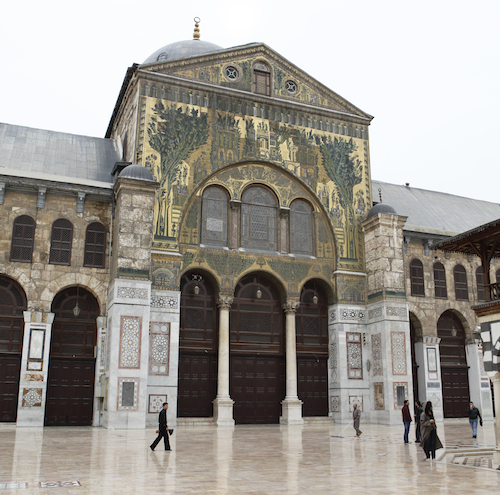
The Great Mosque at Damascus, also known as the Umayyad Mosque, is the first tremendous achievement of architecture in the history of Islam. The mosque was used as a primary point for gatherings after Mecca to strengthen the muslims in their faith and to command the surrounding territories under the Umayyad Caliphate region. Its religious importance was reinforced by its much publicized medical manuscripts and it ranked as a wonder of the world because of its magnificence and scale of construction. The Umayyad Mosque showed the uprise in the political status of Islam as being a major world power. Its height became an architectural prototype in Islamic nature for new mosques being built in the recently established territories.
For thousands of years, sacred buildings have been housed at the Umayyad Mosque site and each of them have been transformed to accommodate the faith of the present time. The oldest layer of architecture uncovered on archeological expeditions is an ancient Aramaic temple that is dedicated to the god Hadad. However, the temple of Jupiter took up this space during the Roman period. Then during the fourth century, it was turned into a church. The church was made bigger to create the Cathedral of Saint John, placed on the western portion of the older temple. After the Islamic gain of Damascus in 661 C.E. The Muslims shared the church with the Christians during the reign of the first Umayyad Caliphate, Mu'awlya Ibn Abi Sufyan. The Muslims prayed in the eastern section and Christians in the western side of the ancient temple. This continued until the reign of Abdul Malek when the prayer space became too little in terms of capacity and the need for the building to represent a new religion. The Caliph negotiated with the Christian leaders to utilize the space, so al-Walid bin Abd al Malik made a promise that all other churches in the area would be kept safe, adding a new church granted to Christians as compensation. During his ten year reign in the beginning of the eighth century al-Walid spoke to the citizens in Damascus: "Inhabitants of Damascus, four things give you marked superiority over the rest of the world: your climate, your water, your fruits and your baths. To these I wanted to add a fifth: this mosque."
References
Jami' al-Umawi al-Kabir (Damascus). (n.d.). Retrieved September 28, 2020, from https://archnet.org/sites/31
Macaulay-Lewis, D., & Macaulay-Lewis, D. (n.d.). Introduction to Islam. Retrieved September 28, 2020, from https://smarthistory.org/introduction-to-islam/


I as well researched the Umayyad architecture. I did mine on the Dome of the Rock. It was not the largest as yours is, but it was the oldest surviving Islamic monument. Our research was very similar, it was interesting to see a different side of the culture I didn't see.
ReplyDelete