Hagia Sophia, Istanbul
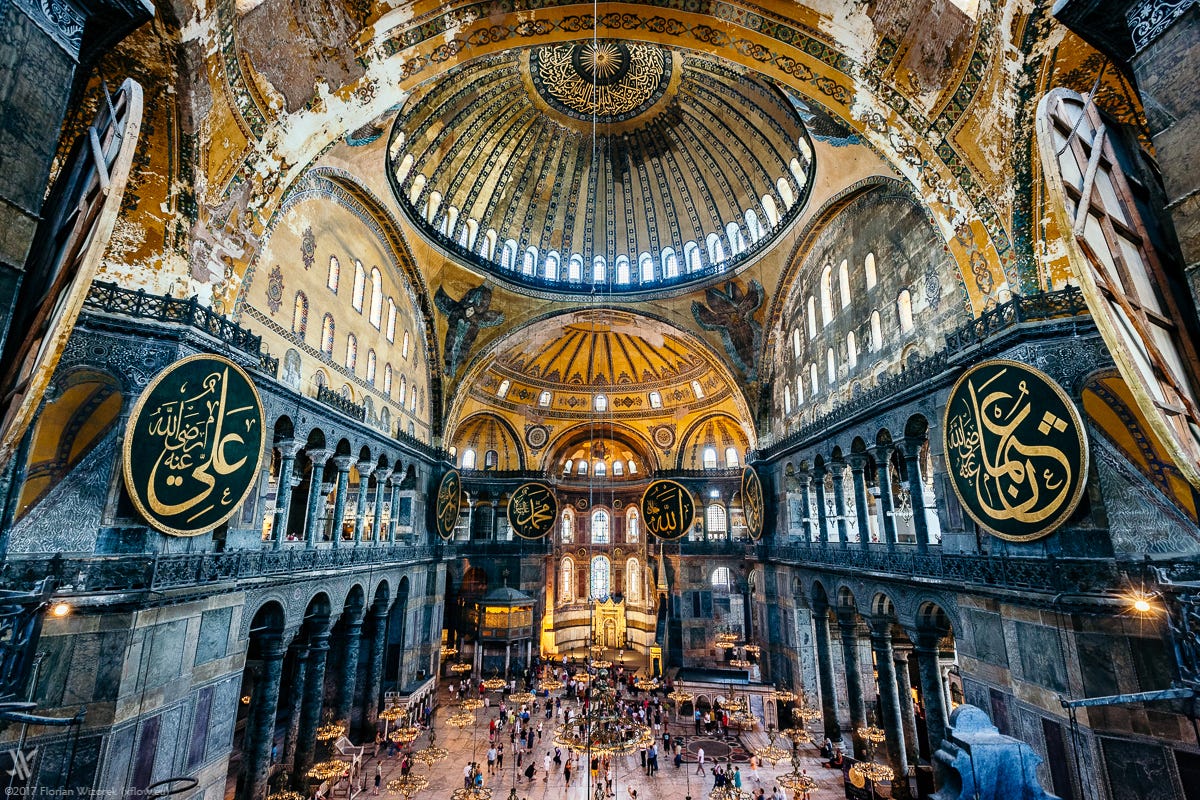
The Hagia Sophia is found in Istanbul, Turkey. It's an enormous architectural wonder that was originally built as a basilica for the Greek Orthodox Christian Church close to 1,500 years ago. Since then, its purpose has changed a multitude of times. Nonetheless, as remarkable as the building is itself, its role in the history of Istanbul is worthy of attention and touches on matters relating to religion, architecture, art, and politics internationally.
Construction of the first Hagia Sophia (Ayasofya in Turkish), was commissioned by the Byzantine Emperor Constantius in c. 360. At this time, Istanbul was known as Constantinople, named after Constantine I, the first ruler of the Byzantine Empire as well as Constantius' father. As a result of the first Hagia Sophia being built with a wooden roof, the structure was burned to the ground in c. 404. This is because of the riots that had taken place from political conflicts Emperor Arkadios, who was in reign at the time.
The emperor after Arkadios, Theodosios II, completed building the second Hagia Sophia structure in c. 415. This also was covered by a wooden roof, which would later prove to be a flaw, and included five naves and an extraordinary entrance. Around a century later, for a second time, the structure was burned during the "Nika revolts" against Emperor Justinian I. Destruction of the building was ordered, and Justinian hired Isidoros and Anthemios, renowned architects, to build the third Hagia Sophia. This third basilica was finished in 537 and thankfully remains standing. The first religious service took place on December 27, 537.
Ever since 1935, the Hagia Sophia has been used as a museum by the national government and it annually attracts around three million visitors. Although, since 2013, Islamic religious leaders have wanted the building to be opened as a mosque. There is growing recognition for the Ottoman era in being a big part of Turkish history. The Hagia Sophia is considered a fundamental mark of that time period, so there are some that are supporters and speaking out for the building to be used as a mosque for a symbol of history. As it stands now, the basilica remains open to tourists.

References
History.com Editors. (2018, January 12). Hagia Sophia. Retrieved September 20, 2020, from https://www.history.com/topics/ancient-greece/hagia-sophia
Hurst, D., & Hurst, D. (n.d.). Byzantine art, an introduction. Retrieved September 20, 2020, from https://smarthistory.org/a-beginners-guide-to-byzantine-art/


Hi Sara! Every time I read the name Constantinople or Istanbul I think of that song, and it makes me laugh. You might be to young but its called "They Might Be Giants." Its crazy to think that this build burnt down twice, it is so beautiful. I really to love the colors used deep blues and gold. Three million visitors seems like a lot but I just looked and Disneyland get 18 million a year, still I would love to see it. Great Job!
ReplyDelete