Nazca Geoglyphs
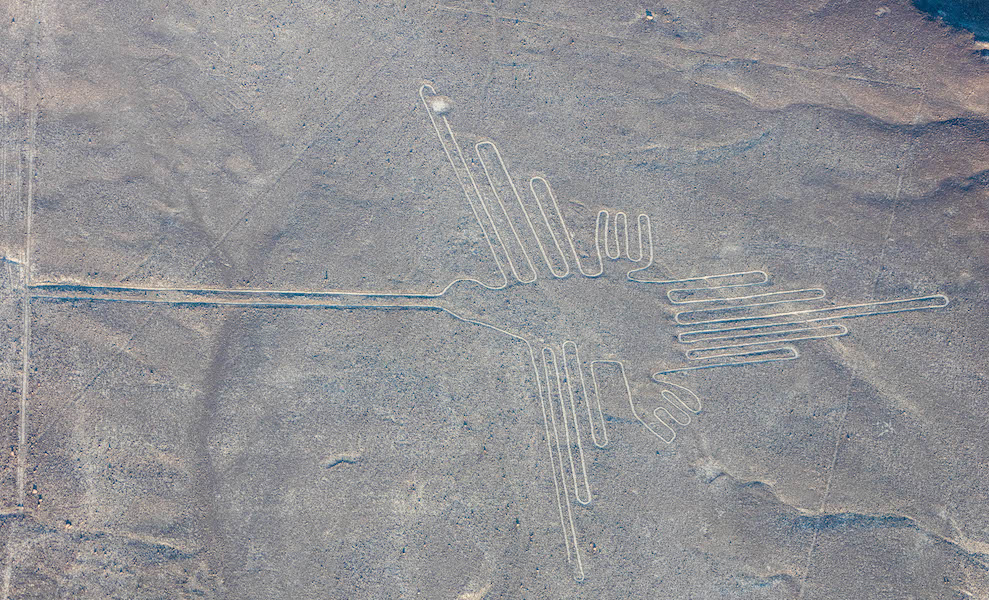 |
| Hummingbird, Nazca Geoglyph, over 300 feet in length, formed approximately 2000 years ago |
About 250 miles south of Lima, Peru, the Nazca Lines are located in the Peruvian coastal plain. Nazca Lines are a collection of massive geoglyphs and there can be three basic types of these:straight lines, geometrical designs, or pectoral representations. There are more than 800 straight lines, 300 geometric, and are best known for the assortment of 70 plants and animals. All of the ancient Nazca geoglyphs were created by the Nazca culture in South America. Unfortunately, the geoglyphs, despite being studied for over 80 years, are still a great mystery to then researchers. Recent research lead to the belief that the lines' purpose was in relation to water. They weren't used as irrigation or a guide to find water, but a ritual to their gods to bring the much needed rain.
The lines are located on an archeological site that is more than 75,000 hectares and is one of the driest places in the world. A hectares is equal to 100- 2.5 acres so thats 75,000- 250 acres. Thats A LOT of land. Because this land is desert, the floor is covered in pebbles of iron oxide with a deep rust color and the ancient people of Nazca created the designs you see today by removing a little over a foot of rock which in turn reveals to sand below that is lighter colored. Most of the geoglyphs were created by making a top of outline (removing rocks from the border), while others had rocks removed from the interior. Given that these were created in a desert, there is a low amount of rain and wind erosion so the geoglyphs have remained basically untouched throughout thousands of years.
Thanks to their location, the Nazca Lines have been spared from a lot of unintentional destruction, but they haven't been completely safe. In 2009, they were affected by the first recorded instance of damage from heavy rainfall. Five years later, an environmental group had damaged an area during a media stunt when they stomped through the upper layer of rocks by the hummingbird to lay down a sign that promoted renewable energy. And lastly, in 2018, a truck driver was arrested after he drove over a portion of these ancient lines leaving deeps scars. After this catastrophe, there is better security and watch over these sites.
References
Jayne Yantz, "Nasca Geoglyphs," in Smarthistory, October 1, 2016, accessed November 18, 2020, https://smarthistory.org/nasca-geoglyphs/.
History.com Editors. (2017, December 04). Nazca Lines. Retrieved November 20, 2020, from https://www.history.com/topics/south-america/nazca-lines


Comments
Post a Comment