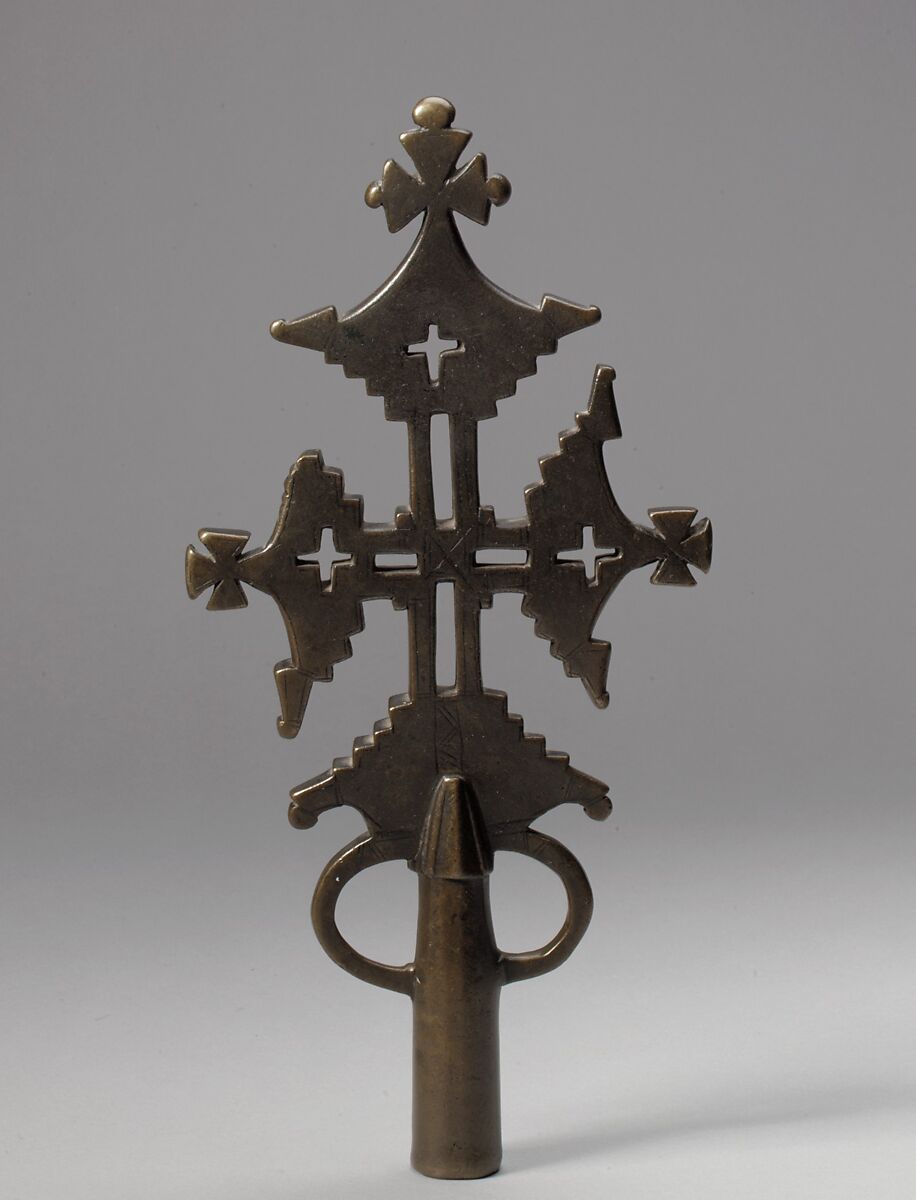
 |
| Processional Cross. ca. 13-14th century, Tigrinya peoples |
Dating to the fourth century, the adoption of Christianity began with the emperor Ezana. The story of Ezana's conversion had been reconstructed and pieced together with his writings from several documents. These documents came from the ecclesiastical histories of Rufinus and Socrates Scholasticus. Both of these narrate how a youth from Tyre, whose name was Frumentius, was shipwrecked and sent to the court of Aksum. Frumentius searched for Christian Roman merchants, was converted, and then proceeded to become the first Bishop of Aksum. So because of this, this story proposes that Christianity was introduced to Aksum via merchants. However, Ezana's commitment to adopt Christianity was more than likely influenced by his wish to make sure the trading relationship with the Roman Empire stayed intact.
Ethiopian crosses such as this one are unique among Christian art for their many varieties and forms. Around 330 C.E., the cross became a symbolic object of great devotion, as this was soon after the conversion of the Aksumite Empire to Christianity. In spite of the ancient past of Ethiopian Christian art, processional crosses coming before the 17th century are quite rare due to the fact that in the 16th century, attacks from Islam devastated the region. As you can see in the picture, there is a metal socket surrounded by two loops. This was used to bind this processional cross to a wooden staff, authorizing it to be carried and held upwards during ceremonial services and processions, parades, where it gets it name. To add to that, the loops held colorful cloths to symbolize the veil of Mary.
Coming out from a central square engraved with a pattee cross, two short horizontal arms and two long vertical arms close in stepped forms. During the casting process, shallow lines are engraved making the broad planes more interesting all while accenting the angular forms of the cross. Dating from the Aksumite Empire (ca. 2nd to the 10th century), the stepped cross is an idea that was created when stepped administrative centers and podiums that were common architectural features of the time. Similar stepped cross creations were found in the churches of Lalibela showing that this cross design was used throughout the region.
References
(n.d.). Retrieved November 03, 2020, from https://www.metmuseum.org/art/collection/search/317877
(n.d.). Retrieved November 03, 2020, from https://www.metmuseum.org/toah/hd/acet/hd_acet.htm


Comments
Post a Comment